“Listen good, I don’t
have nobody” – unfinished
Kid Cudi lyric
So far my work this week has consisted of organizing my pipeline. I have just aligned and combined the images for night 4. They are in a folder below. All in all they look good. There is one outlier that looks a little strange. The cycle 3 Praesepe I-band combination looks like it has a brighter background than the other combined images. Two images for comparison are shown in the comparison. The counts are overall higher in that frame. It doesn’t make sense for this to be similar to the TESS images taken on night two as these frames we’re taken around ‘2020-01-23T11:54:11’ as shown by the header. I’d like to further stream line my code and start using paths instead of cd’ing in my notebook. I am going to try and see Sarah in her office hour to try and figure out how or if this should be implemented in my pipeline. Besides that I’d like to somehow have the centriod coordinates somehow be recovered from the img_prime automatically instead of me going into the file in DS9 and eyeballing it. If I’m able to this I’d argue that the rest of the reduction will be less laborious. Other than that everything seems to be working properly, my stacks look good.

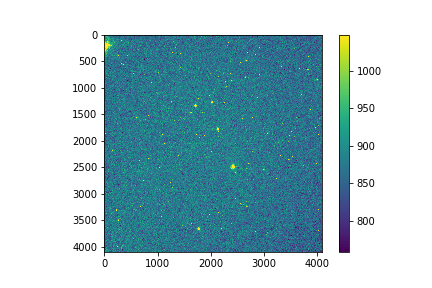
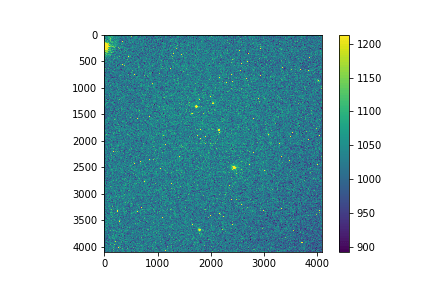
One questions I have is: I have been stacking my images by cycle, but the stacks themselves are offset quite a bit (some more than others), but they are definitley not aligned. It is my instinct that we are going to want every stack to fall on the same pixel as this is how we will identify our cluster members with the region file from the target extraction in class. Should I also try to align these images to one another in order for the lightcurves to be made properly?
After going to Sarah’s office hours most of my questions are answered. The stacks DO all have to be lying on the same pixels in order for us to do differential photmetry properly. This is what I expected but was hoping it wouldn’t be the case (as this requires some editing of the pipeline. The fix, however, kills two birds with one stone. Having all of the images aligned to one makes it such that the centriod coordinates in the cross_image function all the same. No need to automate. No need to keep fishing for coordinates in DS9. Blamo. That being said after I implemented this method some of my stacks look strange. for images with large shifts I have black bars on the left and bottom sections of the image like so:
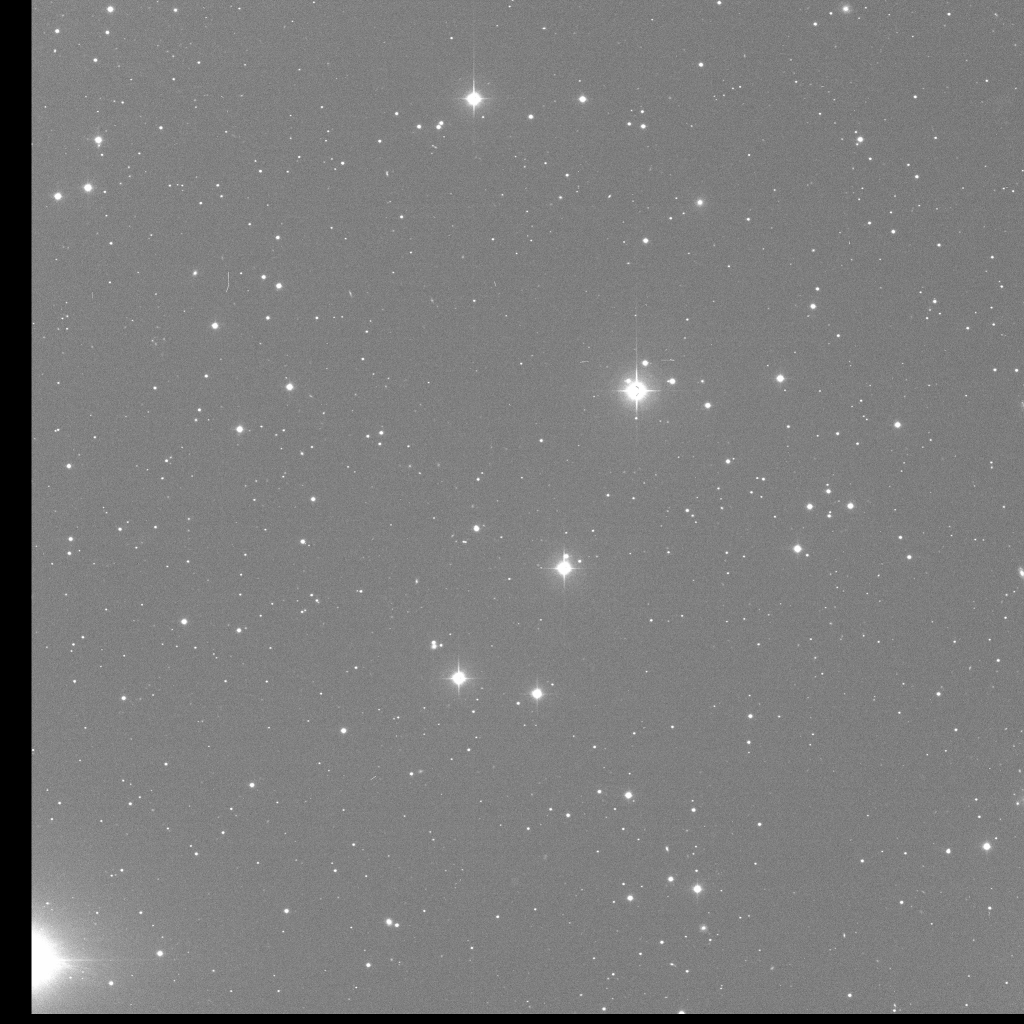
I suspect this is because the image is being moved by so many pixels that there is not data extended to these regions of the image. All of the sources are lying on the same points so it seems that we can do photometry as long as our sources have not been booted off the frame in the top right. That being said, stuff is working and science can be done soon. I am going to try and implement the path method, but also the returns may be diminishing: I only have a couple of nights left to reduce and my pipeline as is seems pretty efficient. So we will see.
Next steps include actually making lightcurves. We have the sources extracted for Praesepe and not TESS. In class we were told to leave TESS alone for now, but i suspect we will somehow need to retrieve the sources we have been looking at. For Praesepe we recovered about 70 sources +/- 1 depending on the sigma threshold and FWHM allowance. My instinct is that we will plop these regions down on our stacks and start trying to look at the flux (not calibrated) through them. Then we can start making lightcurves and hopefully coming to conclusions. I suspect the code will look similar but not the same as our photometry routine from 337, but to be honest I don’t know for sure.
The paper I’ve been digging into the angular momentum review paper written by Bouvier+ in 2013 and the Bailer-Jones+ in 1999. I think that the review will provide some good foundational info, and the Bailer-Jones will be good to provide some context, motivation and methods for our work. The reading’s haven’t been in too much detail since I’ve been tidying up my pipeline, but I hope to spend more time with these papers and get some good edits and revisions in before Friday.

